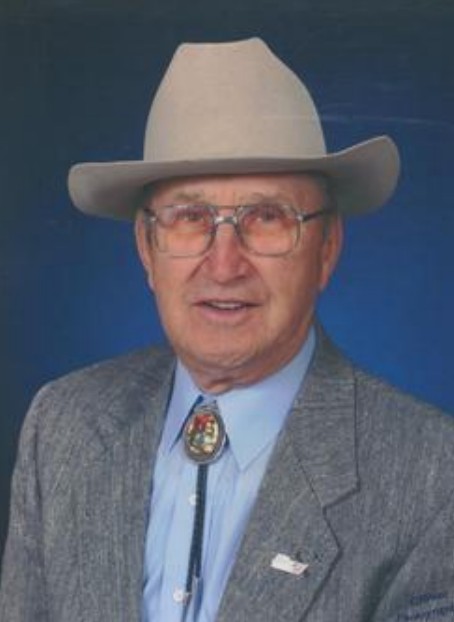
Collection: FND001 - SHSND Foundation - North Dakota Heritage Family Memorial Program
Series: Tribute
Folder: DIG
Item: 23653
Title: Enoch Thorsgard
Date: 3/30/1917-12/16/2015
Inscription/Marks: 3/30/1917
Summary: Enoch Thorsgard was born March 30, 1917, on a farm near Northwood, ND, to Arne and Clara (Markve) Thorsgard.
Enoch epitomized the definition of a lifelong learner. He was always asking questions and challenging the status quo. Few people recognized the amount of the philanthropic and charitable contributions he distributed on a regular basis. His Christian faith and commitment were the hallmark of his life and work.
Enoch was known for his cattle enterprise. He was one of the first cattlemen to bring Charolais cattle to the region. His motto, “Use it up, wear it out, make it do, or do without,” is evidenced by the niche he found feeding cattle byproducts from local processors. The North Dakota State University Saddle and Sirloin Club selected him as the 79th Little International Agriculturist of the Year in 2005.
Enoch Thorsgard wasn’t your typical livestock producer. He worked in the feedlot every day, even though he was 96 years old; his large feedlot was very functional and yet had a simple, inexpensive design; the cattle that ran through the feedlot weren’t the usual steers and heifers being fattened for market; he served several terms in the N.D. House of Representatives; and in 2008 he penned a book outlining his life in North Dakota.
Enoch got his initiation into the livestock industry by hauling cattle. “Back in 1938, ’39, ’40, and ’41, all I did was haul cattle, so that’s how I got to know everybody and learned about the business,” he said. “Then I started farming and have had cattle ever since.”He started out with what he called “a regular farmer’s herd,” a couple hundred stock cows, but the start of the potato processing industry in nearby Grand Forks changed the scope of his livestock operation.
A Simplot plant was generating a large amount of waste from their new potato plant and needed a way to dispose of the waste product.
“When this potato thing came up with Simplot, we had to increase our livestock operation,” he explained. “They wanted me to have 10,000 head to use up the waste, but we usually ran from six to seven thousand in the feedlot.”This “potato mash” by-product was about 80 percent water, and handling and feeding it in the winter posed a problem since the product would freeze in the feedbunks. Additionally, the potato waste had to be hauled every day, no matter the weather, in order to keep the plant operating.
Even though hauling the waste product added a lot of extra work, Enoch said the potato mash was a good source of feed for the cattle.
Things became a little more complicated in the early 1980’s when cattle prices plummeted and many feedlots in the state were forced to close down. The financial crunch impacted Enoch’s operation as well and he told officials at Simplot that he would no longer be able to handle their potato waste.
This prompted Simplot officials in Idaho to make a quick trip to North Dakota to evaluate the situation. Eventually the company agreed to deliver the potato mash to the Northwood feedlot.Simplot had no assurances from Enoch’s sons or grandchildren that they would be interested in continuing the feedlot operation in the future. With no guarantee of a place to deliver the potato mash, the company decided to build a large lagoon for deposit of the potato waste. Shipments of the mash were declining and Enoch cut back on the numbers in the feedlot.
Enoch’s quest for an inexpensive ration didn’t stop with the potato waste. He received 25 semi-loads of cheap wheat from a large grain company that had piled wheat on the ground and had spoilage on the bottom of the pile. “There’s always damaged grain from farmers that had a bin that spoiled and other different things,” he said. “But things are changing. Years ago we were able to pick up a lot of cheap wheat screenings, but with all of the weed chemicals we use now, there aren’t many wheat screenings.
“And the government, years ago, was storing a lot of grain and there were also damaged grain bins so we were able to get cheap grain there,” he continued. “Now, with grain so expensive, farmers take better care of it and they don’t store so much on the farm, which means fewer sources of cheap feed.”
Keeping rations as inexpensive as possible was a practice he carried over into his feedlot design. Instead of investing thousands of feet of pipe to keep the cattle in each lot confined, he used a single electric wire. Even along the feeding bunk, the electric wire held the cattle back.
“That’s the trouble with too many feedlots today. They spend a lot of money on a fancy feeding facility, and when they are done building, they don’t have enough funds to put cattle in the feedlot,” he explained, justifying his low-cost method.
Enoch also questioned the wisdom of some who suggested we need to finish out more calves in the state. Instead, he felt the push should be to background more cattle in the state and leave the finishing to others.
“Cattle feeding up here is a tough thing. You have to contend with muddy lots, cold weather,” he noted. “Everybody says we need to feed more cattle in North Dakota. It’s okay for backgrounding – they make some money – but to finish cattle in the state, in many years it has not been profitable.”
At one time, Enoch finished out calves, but never backgrounded calves from his own cow-calf operation because the potato mash-based ration wasn’t a good backgrounding feed. Several years later he switched from feeding out calves to putting stock cows in his lots.
He had buyers attend the various livestock sale barn sales in the two Dakotas and they were asked to purchase stock cows that were being culled for various reasons – some were just getting too old, others might not have gotten bred, or were pregnant but were too late to fit into the farmer’s calving program. These stock cows were brought to Enoch’s feedlot, where each one was checked for pregnancy. The pregnant cows were allowed to calve.
Most of these cows remained in the feedlot for a period of four to five months before being sent to slaughter, with a large majority of them going to a kosher slaughter facility for the Jewish market.
“There’s very few feedlots that feed just cows,” he said, “and it works well for us. If other buyers purchased these same cows, they would likely be sent to slaughter and if the cow was pregnant, that calf would never be born.”
Even though the focus had been on the feedlot operation, Enoch’s Thorsgard Sunrise Acres also had a cow-calf operation made up mainly of “Balancer” cows, a Black Angus and Gelbveih cross.
“It’s pretty much proven that you should have a cross�bred cow,” he said, “and those cows should be bred to an Angus bull.”
Over the years, that cowherd had changed both in makeup and numbers to reflect the changes in the beef industry.
When asked about changes he had witnessed in the beef industry, he included the decline in the number of operations with just a few head of stock cows.
“I used to rent out bulls, since most farmers had a few cows and hated to buy a bull,” he recalled. “At one time I was renting out over a couple hundred bulls all over the country. But that’s of the past. There are only a few big breeders now.”
He also recalled that when he was younger, farmers had cows of every color in their herd – there were few predominately black herds. But now many of the herds are black, even if they have some Simmental or Shorthorn in the herd.
“The Angus breed has done a tremendous job marketing Angus cattle. Grocery stores and restaurants advertise they specialize in Angus beef and that’s why the packing houses want Angus cross cattle,” he noted.
He had tried to get into the purebred side of the industry a few times, but readily admitted it was a specialized thing he just wasn’t made for.
“At one time I thought I would like to get into Polled Hereford cattle and bought a heifer down at the Winter Show in Valley City,” he recalled. “But when she calved she didn’t have one drop of milk… not one drop. She had been fed heavy before I bought her and her udder was full of fat, so that settled my wanting to raise Polled Herefords.”
Over the years, it wasn’t just weather and tough financial times that the beef industry had to face. Enoch recalled the difficulty exotic breeds had in establishing themselves
in the state. They faced opposition on several levels from the established English breeds – Angus, Hereford, and Shorthorn.
But in the end, they were forced to accept these new breeds,” he said. “The established breeds hated to see these new breeds come in and spoil their good thing. But they eventually saw the handwriting on the wall that these exotics were so much bigger and better.”
Two of Enoch’s sons were involved in the farm – Grady handled the grain side of the operation, and John was in charge of the shop, doing maintenance on the farm equipment and the fleet of trucks the operation owns.Seven grandsons were also involved but Enoch still managed the cattle side of the enterprise and most days was out mingling with the cattle.
In addition, a long-time employee, Harris Aftret, played a large role in the success of Sunrise Acres. He started working for Enoch in 1947 when he was 18 years old.
Rep. Wayne Trottier said his longtime friend started in the agricultural industry essentially from scratch but later gained great success, accruing multiple awards over the
years. Several friends noted his spirited personality, always interested in people, and with a seemingly endless source of energy. He was driving around his feedlot up until about a week before he died, said Trottier.
“He wasn’t afraid to delve into anything,” he said. “He was an entrepreneur at its greatest. I truly, truly respected and admired him.”
Enoch’s passion for the Lord and for his state of North Dakota was demonstrated in his dedication to the North Dakota Heritage Center, his 12 years in the North Dakota House of Representatives, and his pioneering and promoting of the North Dakota Family Alliance.
Thorsgard, a Republican, served in the state House of Representatives from 1969 to 1980, during which time he strongly pushed for initial funding for the state Heritage Center in Bismarck. Virginia Nelsen, executive director of the State Historical Society of North Dakota Foundation, said she understood he went “desk to desk” to develop a funding plan.
“I don’t know if it was his favorite project, but it was something he was very proud of,” she said. “He almost single-handedly picked up the votes on the floor.” He followed the progress of it until the end, showing up last year among the thousands for the grand opening of the Center’s expansion. “He was just one of those aggressive, staunchly involved folks who didn’t give up,” Nelsen said.
Enoch was the driving force behind the creation of the state Christian Coalition and a supporter of the North Dakota Family Alliance, a group dedicated to protecting family values and religious freedoms.
Suzanne Bowman, a former employee at the Christian Coalition, said Thorsgard worked hard to gather support for the organization in his later years, at an age when others choose to relax. He chose the former Miss North Dakota winner as a spokeswoman after she was publicly outspoken about her faith.
“He was a tremendous mentor in my life,” said Bowman, who now lives in Jamestown with her husband, pastor of Victory Lutheran Church. “It’s impossible to measure the intensity of his life. He was fully engaged to the last second and hour. I so deeply respect that in him.”
Tom Freier, executive director of the North Dakota Family Alliance, said the organization named its lifetime achievement award after Thorsgard, calling it “The Enoch.” “He was a great man – a wonderful father and someone whom everyone can look up to with respect,” he said.
Enoch’s love and generosity toward his family surpassed all his other efforts. His grandchildren and great�grandchildren put it best. “He was an awesome man of God and has done so much for so many people around Northwood and around the world. He is leaving a legacy like no other. My family and I have learned countless irreplaceable life lessons from him. Lessons on faith, family, life, love, and success. He was the prime example of a God-fearing and faithful man. His life and legacy will be celebrated among his family and friends for generations to come.
Enoch Thorsgard, at the age of 98, passed away December 16, 2015, at his home in rural Northwood.
Survivors included his wife, Madeline; children: Carol (Harold) Luecke, Grady (Marilyn) Thorsgard, John (Dona) Thorsgard, Ruth (Robert) Draxton, and a son-in�law, Lonney Eastvold; 24 grandchildren and 11 spouses, 28 great-grandchildren, and a sister-in-law, Doris Thorsgaard.
Enoch was preceded in death by a son, Luke and a daughter, Betty; parents, Arne and Clara (Markve)Thorsgaard; sister, Anna (Adolph) Kordahl; brothers: Harold, Arne, and Arthur Thorsgaard.
(Much of the information for this tribute is from a 2014 article by Dale Hildebrant for Farm & Ranch Guide.)
Red ID: FND_I_74321 Image ID: 556754 Image Notes: FND001 23653