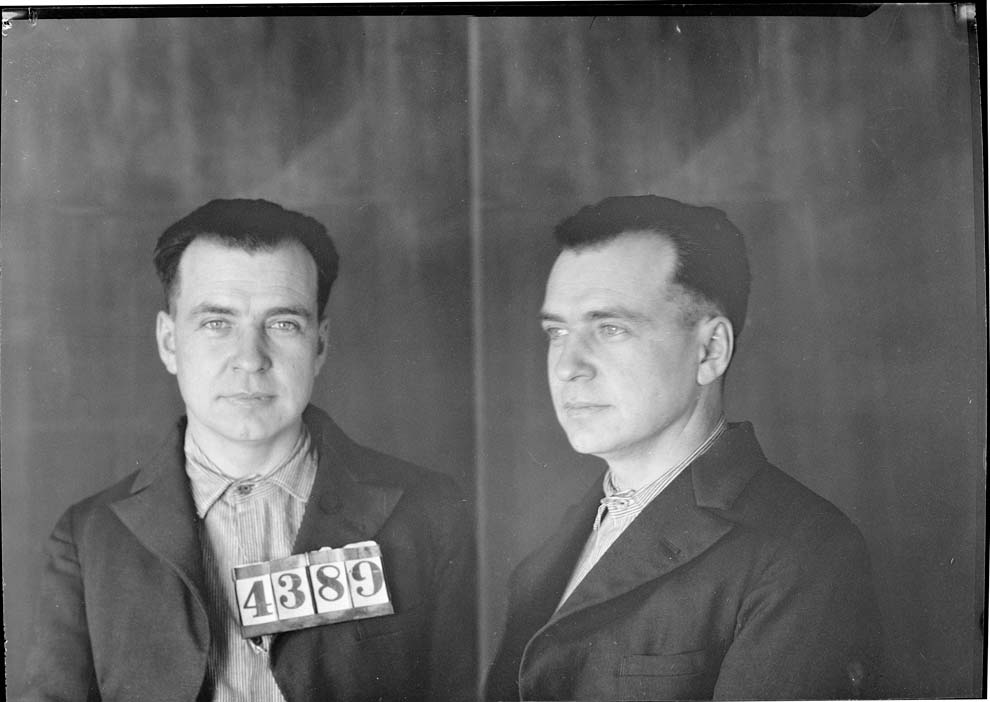
This image may be restricted. Contact reference staff for assistance.Collection: 30366 - Corrections, Department of. State Penitentiary, Security Mug Shot Books.
Folder: 0019
Item: 04389
Title: 4389 Hastings, John J.
Date: Undated
Summary: John J. Hastings was born in 1892 in Fort Totten, North Dakota. His father was a music teacher at the fort. Hastings attended the University of North Dakota in Grand Forks. He worked at the Moody store in Fargo, and he also worked at banks in Grand Forks, Minot, and Fargo. In 1914, he married Jeanne MacDonald. Around this time (the mid to late 1910s), the Nonpartisan League (NPL) rose to dominate the political landscape of North Dakota. Hastings became an early and prominent member of the NPL, serving as its financial secretary. He was also heavily involved with the NPL's enterprises (like the Consumers United Stores Company) and frequently collaborated with other NPL members, such as Thomas A. Box, Kimball Porter, and William Olson. He was reportedly involved in the early stages of the United States Sisal Trust, an ill-fated business venture of the NPL in Florida, before it was taken over by J. R. Waters and J. W. Brinton. However, it was the reorganization of banks that Hastings was most involved in. Box and Hastings organized banks, by purchasing stock, for the NPL across the state (Casselton, Grand Forks, Hatton, Knox, etc.). Some banks were being purchased by a dubious method: the men would borrow money from the bank and then turn around and use these funds to buy the bank. The NPL was securing a controlling interest in banks without putting any money into them. In the fall of 1917, the Scandinavian American Bank (SAB) was indirectly purchased by the NPL, via Hastings, Kimball, and the League Exchange. The League Exchange was an influential side venture of the NPL, which was established by a few prominent members to assist in the financing of the NPL's various projects (such as banking, newspaper publishing, and merchandising). Both Hastings and Kimball joined the bank's board, and Hastings became the bank's vice president. Allegedly, the bank was purchased at the direction of NPL leaders A. C. Townley and William Lemke. The SAB was purchased to serve as the depository for the NPL's revenue and to finance its business ventures. Box and Kimball took a more hands-off approach with the banks, while Hastings was more hands-on. He served as vice president at multiple NPL banks in the state. Hastings and Box typically charged a 10% commission for their work organizing the banks, which was legal, but it earned the suspicion of the State Banking Board. In early 1919, William Langer (Attorney General) and Thomas Hall (Secretary of State), making up a majority of the State Banking Board, decided to investigate the reorganization of the American National Bank in Valley City into the American Exchange Bank. It was determined that Box and Hastings had purchased the bank for $15,000 less than what had been represented to the stockholders. The board forced the two to repay the $15,000. The NPL received backlash over this Valley City bank deal, so much so that Townley had to publicly distance himself from Box and Hastings. Also, in March 1919, Hastings stepped down from his active role in the SAB. He was replaced on the bank's board by NPL member Spurgeon Odell. After the Valley City incident, Langer and Hall remained suspicious of the NPL's banking practices (and dissatisfied with the NPL's leadership). This led to their investigation of the SAB in the fall of 1919. The SAB was temporarily closed, and the issue created a scandal that pulled in other banks, including the newly formed Bank of North Dakota. Hastings was one of the individuals at the center of the scandal. Out of this investigation, a June 1918 letter was made public. The infamous correspondence became known as the "shoot it to the other banks" letter. In the letter, Roy Halliday (then serving as Deputy State Examiner) advised Hastings (then vice president of the bank) that if state examiners object to any of the "paper" at the SAB he should tell them "it will be removed at once" to get a clean report, but instead it should be transferred to other NPL banks and then moved back later. Opponents of the NPL, particularly the Independent Voters Association (IVA), accused the NPL of political favoritism and poor banking practices. By the 1921 legislative session, the NPL's opposition, the IVA, had gained control of the House and held investigations into the programs and ventures of the NPL. This included its banks. It was determined that suspicious loans were given to Box and Hastings. Also around this time, some banks organized by the two men found themselves in financial trouble and were forced to close (Hatton, Grand Forks, and the SAB). After the special election in October 1921, the IVA was in control of state government. Hastings, having taken a more hands-on approach with the banks, faced IVA litigation. In early 1922, he was arrested in Seattle, having previously moved out of the state, and charged with embezzling from the SAB. He was released on the promise of bail, but then he disappeared. Two weeks later, he surrendered to authorities in Sacramento, California, and he fought his extradition back to North Dakota. Assistant Attorney General George F. Shafer represented the state in a hearing before California Governor William D. Stephens. Stephens granted the state's request and Hastings was brought back to North Dakota. He faced additional charges and was arrested again in May 1922 and December 1923. The charges would either be dismissed or Hastings would be acquitted. Beginning in the 1920s, he became involved in the mining industry for many years, and he operated mines in Montana, Oregon, and Washington. In February 1925, he again involved himself in the banking industry and became the president of the state bank in New England, North Dakota. Less than two months later, the bank was forced to close. In October 1925, Hastings was arrested in Seattle. He would be charged with embezzlement and violating the state's blue sky law. In June 1926, he pleaded guilty. His attorney, Usher L. Burdick, requested time a delay in sentencing to give Hastings time to raise funds to pay back the alleged embezzled amount. However, in October 1926, he was sentenced to 5 years in the state penitentiary. He appealed to the N.D. Supreme Court, but his sentence was upheld. His prison sentence began in late October 1926. In July 1928, the state pardon board granted him a "leave of absence" and then granted him parole a few months later in December. He resided in Oregon and Washington for the rest of his life. Hastings died in 1957.
Red ID: SG_I_123002 Image ID: 114651 Image Notes: 30366-04389